
Roughly 1 in 8 American adults has now tried a GLP-1 receptor agonist. Semaglutide (Ozempic, Wegovy) and tirzepatide (Mounjaro, Zepbound) have reshaped the weight loss landscape faster than any pharmaceutical class in recent memory. What gets less attention is what these drugs are doing to the gut.
Not the nausea. Everyone knows about the nausea. I mean the deeper, structural changes to your microbiome, your gut motility patterns, and your nutrient absorption. The stuff that shows up months after starting treatment, when the initial side effects have faded but something still feels off.
How GLP-1 agonists actually work in the gut
Most coverage of Ozempic focuses on appetite suppression and blood sugar regulation. Those are downstream effects. The primary mechanism happens in the gut itself.
GLP-1 (glucagon-like peptide 1) is a hormone your L-cells produce naturally in the small intestine after eating. It does several things simultaneously:
- Slows gastric emptying (food stays in your stomach longer)
- Signals the pancreas to release insulin
- Suppresses glucagon secretion
- Communicates satiety to the brain via the vagus nerve
Semaglutide mimics this hormone at much higher and more persistent levels than your body produces naturally. Your natural GLP-1 spike lasts minutes. A weekly semaglutide injection maintains elevated levels for days.
The interesting part. That prolonged gastric slowing is not just an appetite trick. It fundamentally changes the environment your gut bacteria live in. Transit time, pH levels, nutrient availability at different points in the intestine: all of these shift when you slow the entire conveyor belt down by 30 to 40 percent.
What the microbiome research shows
The data here is still early but increasingly consistent. A 2023 study by Tsai et al. published in Diabetes Care found that 16 weeks of semaglutide treatment produced measurable shifts in gut bacterial composition. The key findings:
- Akkermansia muciniphila increased significantly. This is actually a positive signal. Akkermansia is associated with improved gut barrier function and metabolic health. More on this species in a moment.
- Overall diversity decreased. Shannon diversity index dropped by an average of 0.4 points. This is a moderate decline and warrants monitoring.
- Firmicutes-to-Bacteroidetes ratio shifted toward Bacteroidetes, which tracks with what we see in caloric restriction generally.
- Bifidobacterium populations declined in roughly 60% of participants.
A separate 2024 analysis by Marques et al. in Gut Microbes found similar diversity reduction but noted that the clinical significance was unclear. Some participants maintained healthy diversity throughout treatment. Others saw dramatic drops. The variable seemed to be baseline diet quality, particularly fiber intake.
The takeaway is not that GLP-1 drugs destroy your microbiome. They reshape it in ways that mirror caloric restriction, but they do so faster and more aggressively than most dietary interventions.
The GI side effects nobody prepares you for
Everyone who prescribes semaglutide mentions nausea. Fair enough. But the gut-related side effects extend well beyond that initial adjustment period.
Gastroparesis-like symptoms
The delayed gastric emptying that makes you feel full is, pharmacologically speaking, the same mechanism behind gastroparesis. In clinical trials, roughly 20% of patients on the higher semaglutide doses reported symptoms consistent with gastroparesis: feeling full hours after eating, bloating, and in some cases, food coming back up partially digested.
Sodhi et al. published a retrospective analysis in JAMA (2023) documenting a 4.2x increased risk of bowel obstruction among GLP-1 users compared to matched controls taking bupropion-naltrexone. That number needs context: the absolute risk was still very low (under 1%). But it is not trivial.
Constipation, not just nausea
The prescribing information lists nausea, vomiting, and diarrhea as the top GI side effects. What it underemphasizes is constipation. In practice, constipation becomes the dominant complaint after month 2, once nausea subsides.
The mechanism is straightforward. Slower transit time means the colon has more opportunity to reabsorb water from stool. The result is drier, harder stool and less frequent bowel movements.
I spoke with three registered dietitians who specialize in GLP-1 patient support. All three independently cited constipation as the number one ongoing GI complaint, ahead of nausea.
SIBO risk
Slower gut motility reduces the effectiveness of the migrating motor complex (MMC), the "cleaning wave" that sweeps bacteria out of the small intestine between meals. Reduced MMC activity is one of the primary mechanisms behind small intestinal bacterial overgrowth (SIBO).
No large-scale study has yet quantified the SIBO risk from GLP-1 use. But the mechanistic logic is sound, and gastroenterologists I have talked to are watching for this pattern in their long-term patients.
The fiber and nutrient gap
Here is a problem that compounds quietly. When you eat 40 to 60 percent less food, as many GLP-1 users do, you are also consuming 40 to 60 percent less fiber. And less of every micronutrient.
The average American already eats roughly 15g of fiber daily, about half the recommended 25 to 30g. Cut that intake in half again, and you are operating at 7 to 8g. That is not enough to maintain a healthy microbiome, regardless of what any medication is doing.
What the data actually suggests. The patients who maintain gut health on GLP-1 drugs are almost universally the ones who deliberately increase the nutrient density of their reduced food intake. Calorie reduction without nutrient optimization is where the problems start.
Practical recommendations for GLP-1 users
Fiber first. If you take nothing else from this article: prioritize fiber. A psyllium husk supplement is the easiest way to maintain intake when food volume drops. Start with 5g daily and work up to 10 to 15g. Take it with plenty of water. Do not take it within an hour of your other medications.
Electrolytes matter more. Reduced food intake means reduced sodium, potassium, and magnesium intake. Magnesium glycinate specifically helps with the constipation issue while addressing a likely deficiency.
Probiotic support. A high-quality multi-strain probiotic can help offset the diversity decline. Look for one with documented Bifidobacterium strains, since that is the genus most consistently reduced. Seed DS-01 and Garden of Life Dr. Formulated Probiotics both contain relevant strains.
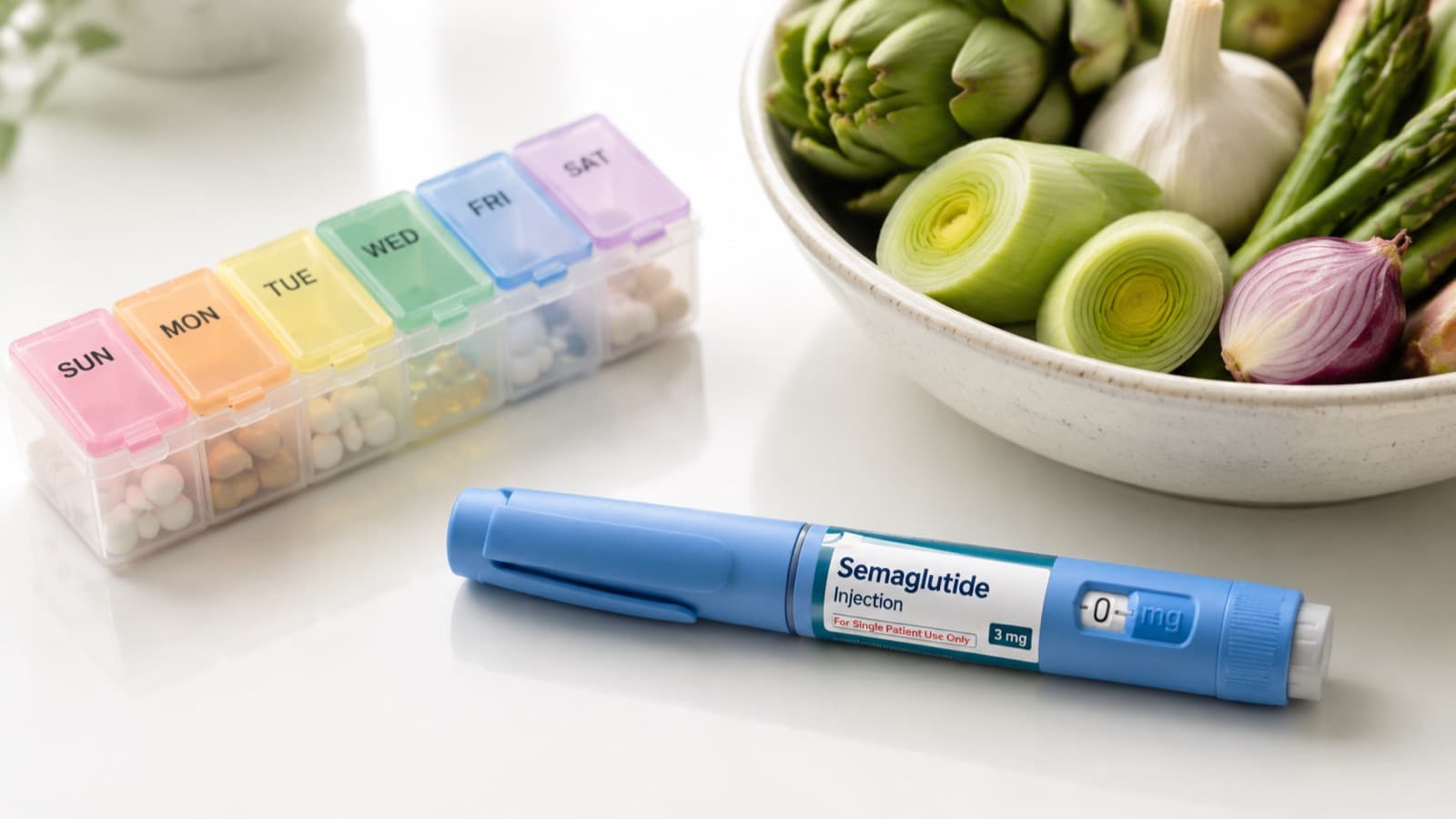
Prebiotic foods. Even if you are eating less overall, you can bias toward prebiotic-rich foods: asparagus, garlic, onions, leeks, slightly green bananas. These feed the bacteria that are most under pressure during GLP-1 treatment.
The Akkermansia connection
One genuinely interesting finding in the GLP-1 microbiome research is the Akkermansia increase. This bacterium lives in the mucus layer of the intestinal wall and is associated with improved metabolic markers, reduced inflammation, and better gut barrier integrity.
The irony is that some researchers believe Akkermansia may be partly responsible for GLP-1's metabolic benefits, not just a side effect of the drug. Akkermansia itself stimulates GLP-1 production. So semaglutide may be creating a positive feedback loop: drug increases Akkermansia, Akkermansia produces more natural GLP-1, the combined effect exceeds what the drug alone would achieve.
Depommier et al. published a landmark trial in Nature Medicine (2019) showing that pasteurized Akkermansia supplementation improved metabolic markers in overweight humans. If you are interested in this species specifically, I wrote a deeper dive: Akkermansia: The Gut Bacteria Behind GLP-1 and Longevity.
Companion supplements for GLP-1 users
Based on the research and the patterns I am seeing, here is what I would consider if I were on a GLP-1 agonist. This is not medical advice. Talk to your prescribing physician.
| Supplement | Purpose | Timing | |---|---|---| | Psyllium husk | Fiber maintenance | Morning, with water | | Magnesium glycinate | Constipation + mineral support | Evening | | Multi-strain probiotic | Diversity support | Morning, empty stomach | | Butyrate supplement | Colonocyte fuel, barrier support | With meals | | B-complex vitamin | Nutrient gap coverage | Morning, with food |
Long-term considerations
The honest answer is that we do not have long-term microbiome data on GLP-1 users. The drugs have been used for diabetes since 2017, but high-dose weight loss use only became widespread in 2022-2023. Five-year microbiome data simply does not exist yet.
What we can say is this: the gut changes are not inherently harmful, but they require active management. The patients who treat GLP-1 therapy as permission to ignore their diet are the ones most likely to develop serious gut complications. The patients who use it as a tool while maintaining fiber, micronutrient, and probiotic intake tend to fare well.
If you are currently on semaglutide or tirzepatide, get a baseline gut health test before your next dose adjustment. Know where your diversity stands. Track your fiber intake for one week. You might be surprised how low it is.
For context on testing options, see 5 Gut Health Tests Actually Worth Your Money in 2026.
The bottom line
GLP-1 drugs are effective. The weight loss and metabolic data is strong enough that arguing against their utility would be intellectually dishonest. But they are not metabolically free. Your gut is absorbing the cost, and that cost goes unmanaged in most clinical settings.
The fix is not complicated. More fiber. Strategic probiotics. Nutrient density over calorie counting. Regular monitoring.
The hard part is that nobody prescribing these drugs is having this conversation with patients. If your doctor handed you a semaglutide prescription without discussing gut health, that is a gap you need to fill yourself.