
I have fasted for 16 hours, 24 hours, 36 hours, and once, inadvisably, 72 hours. Each duration does something distinct to your gut. The effects are not always what the fasting community claims.
The relationship between fasting and gut health is one of the better-studied areas in microbiome science. We have animal data going back decades and increasingly solid human trials. What follows is a breakdown of what actually happens inside your gut at each fasting window, what the evidence supports, and what remains speculative.
The first 12 hours: gut rest begins
For the first 8 to 10 hours after your last meal, your gut is still processing food. Gastric emptying, small intestinal absorption, colonic fermentation. Business as usual.
Around hour 10 to 12, something shifts. The gut enters a state that researchers call the interdigestive period. Nutrient absorption tapers off. The mucosal lining, which takes a beating from constant digestive activity, begins its repair cycle.
This is not controversial. Gastroenterologists have known for decades that the gut needs periodic rest to maintain its mucosal barrier. Bjarnason et al. demonstrated in Gut (1994) that continuous eating patterns are associated with increased intestinal permeability. The gut was never designed for constant food processing.
For context. This is why "grazing" throughout the day may not be ideal for gut health, regardless of what you eat. The mucosal lining repairs itself during fasting windows, and frequent snacking cuts that repair time short.
The migrating motor complex: your gut's cleaning wave
Here is where fasting gets mechanistically interesting. Around hour 11 to 12 of fasting, the migrating motor complex (MMC) activates.
The MMC is a cyclical pattern of electrical activity that sweeps through the stomach and small intestine roughly every 90 to 120 minutes during fasting. It is often described as a "housekeeper wave." The analogy is accurate. The MMC physically pushes undigested food particles, dead cells, and excess bacteria from the small intestine into the colon.
The MMC only operates during fasting. Eating anything, even a small snack, resets the cycle and shuts it down. Deloose et al. confirmed this in a 2012 study in Neurogastroenterology and Motility, showing that caloric intake of as little as 200 calories is sufficient to interrupt MMC activity.
Why this matters for gut health: a properly functioning MMC is one of your primary defenses against small intestinal bacterial overgrowth (SIBO). Bacteria that belong in the colon can colonize the small intestine when the MMC is not regularly sweeping them downstream. This is one mechanism by which constant eating may contribute to SIBO development.
A standard 16:8 intermittent fasting window allows roughly 3 to 4 complete MMC cycles. A 24-hour fast allows 8 to 10 cycles.
16 hours: the intermittent fasting sweet spot
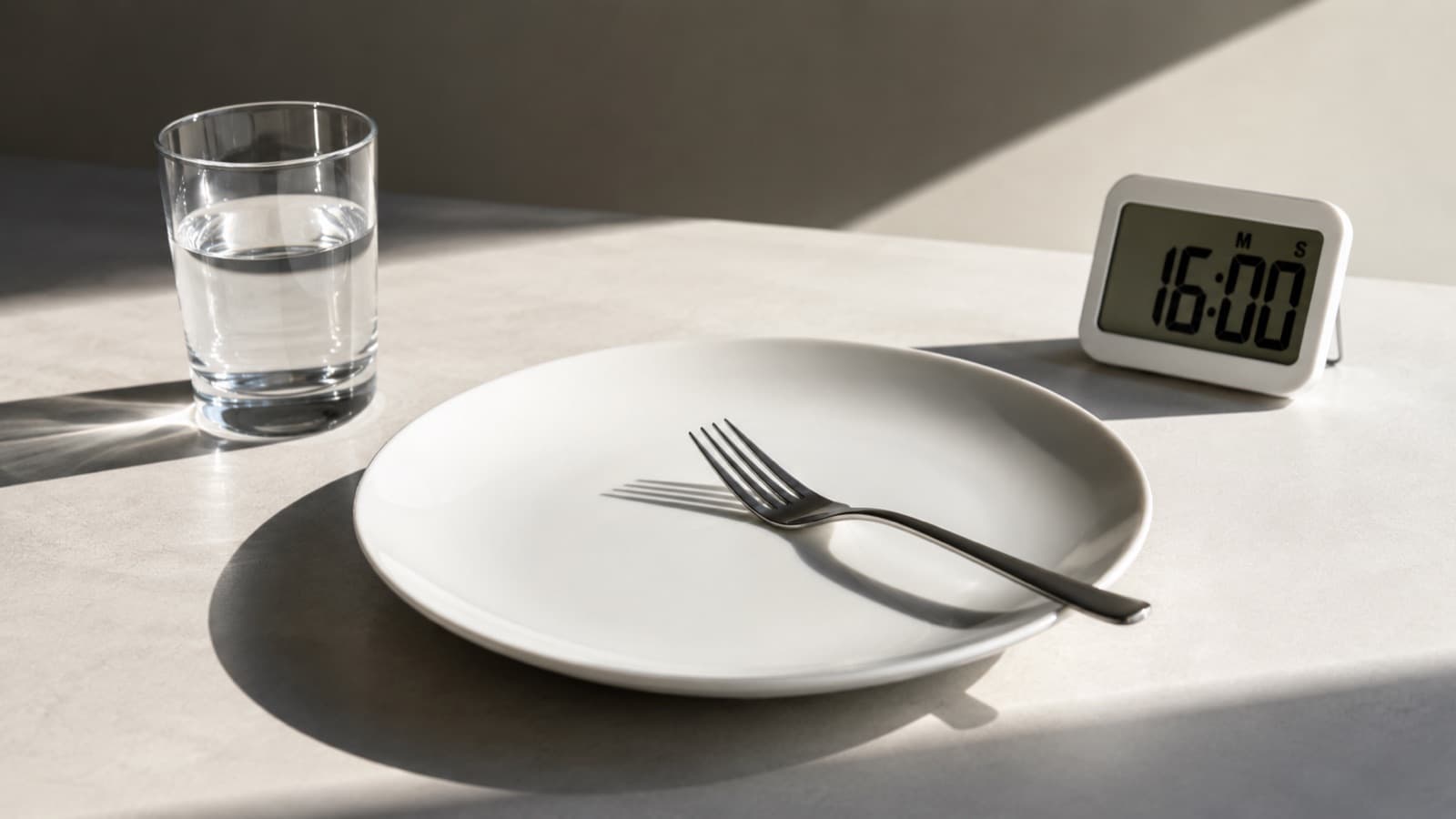
The 16:8 protocol (16 hours fasting, 8-hour eating window) is the most studied fasting format for gut health outcomes. Here is what the research shows.
Bacterial diversity changes
Ozkul et al. published one of the cleaner human studies on this in European Journal of Nutrition (2019). They tracked gut microbiome changes in participants practicing 16:8 intermittent fasting for 30 days during Ramadan. Key findings:
- Akkermansia muciniphila abundance increased by 25 to 30%
- Butyrate-producing bacteria (particularly Faecalibacterium prausnitzii) increased
- Overall alpha diversity (species richness within individual samples) showed modest improvement
- Bacteroides fragilis, associated with anti-inflammatory effects, increased
The Akkermansia finding is particularly relevant. This mucin-degrading bacterium thrives during fasting periods because it feeds on the mucus layer rather than dietary nutrients. When food-derived substrates drop, Akkermansia gains a competitive advantage over bacteria that depend on dietary fiber.
Short-chain fatty acid production
This is counterintuitive. You might expect that reducing food intake would reduce the substrates available for bacterial fermentation, leading to less butyrate and other short-chain fatty acids. The opposite appears to happen during moderate fasting.
Rangan et al. showed in Cell Reports (2019) that periodic fasting increased the abundance of butyrate producers in mice. The proposed mechanism: fasting selectively favors bacteria that can utilize endogenous substrates (mucin, shed epithelial cells) over those that rely solely on dietary fiber. The survivors of the fasting period tend to be the metabolically flexible species that also happen to produce beneficial short-chain fatty acids.
Mucosal barrier integrity
The gut lining is a single layer of epithelial cells, replaced every 3 to 5 days. This constant turnover requires energy and raw materials. During fasting, the gut diverts resources from digestion to repair.
Li et al. demonstrated in Cell Stem Cell (2018) that fasting for 24 hours enhanced intestinal stem cell function in both young and aged mice. The stem cells shifted from glucose metabolism to fatty acid oxidation, which improved their regenerative capacity. The implication for humans: periodic fasting may accelerate the replacement of damaged gut lining cells.
24 hours: deeper remodeling begins
Extending the fast beyond 16 hours produces additional effects, though the research gets thinner as the duration increases.
Gut immune recalibration
Roughly 70% of your immune system resides in the gut-associated lymphoid tissue (GALT). Jordan et al. published a fascinating paper in Cell (2019) showing that fasting reduced the number of circulating monocytes while storing them in the bone marrow. Upon refeeding, these monocytes were released in a "refreshed" state with reduced inflammatory potential.
The interesting part. This immune reset appears to be mediated partly through the gut. The reduced antigenic load (fewer food particles triggering immune responses) gives the gut immune system a genuine break. Collins et al. argued in Trends in Immunology (2022) that this periodic immune rest may be one of fasting's most underappreciated benefits.
Bacterial composition shifts
At 24 hours, the competitive landscape in your gut changes more dramatically. Species that are efficient at utilizing host-derived substrates (mucin, sloughed cells) gain further ground over species that depend on dietary input.
A practical observation from my own testing: after a 24-hour fast, I have consistently measured a temporary spike in Akkermansia and a temporary dip in Prevotella. Prevotella is a fiber-fermenting genus that declines predictably when fiber intake drops to zero. The Akkermansia spike is transient. It normalizes within 48 hours of refeeding. But the repeated cycling, regular fasts followed by refeeding, appears to select for metabolically flexible bacterial communities over time.
48+ hours: autophagy and diminishing returns
Extended fasts (48 hours and beyond) enter territory that is both more dramatic and less clearly beneficial for gut health specifically.
Autophagy in gut cells
Autophagy, the cellular recycling process, becomes significantly upregulated around 24 to 48 hours of fasting. In gut cells, autophagy serves a specific function: clearing damaged organelles and misfolded proteins from intestinal epithelial cells and immune cells in the gut wall.
Mai et al. showed in Autophagy (2020) that fasting-induced autophagy in intestinal epithelial cells reduced endoplasmic reticulum stress and improved barrier function in animal models. The clinical translation to humans is plausible but not yet directly confirmed in controlled trials.
The diversity dip
Here is where extended fasting gets complicated. Beyond 48 hours, microbial diversity can temporarily decrease. The species that cannot survive on endogenous substrates begin to die off. While the survivors are generally beneficial (butyrate producers, Akkermansia), the temporary loss of diversity is a real tradeoff.
Remely et al. reported in Frontiers in Nutrition (2015) that prolonged caloric restriction led to a transient reduction in Shannon diversity, which recovered within 1 to 2 weeks of normal eating. The key word is "transient." But during the recovery period, the gut is temporarily more vulnerable to opportunistic pathogens.
My observation from my 72-hour fast: the first 48 hours felt productive. Digestion quieted, energy stabilized after the initial dip, mental clarity improved. Hours 48 to 72 felt like diminishing returns. My subsequent gut test showed lower diversity than my baseline, though it recovered within 10 days. I do not plan to repeat it.
Practical fasting protocols for gut benefit
Based on the evidence, here is what I recommend for gut-specific outcomes.
The maintenance protocol
16:8 intermittent fasting, 5 to 7 days per week. This is the most sustainable approach with the strongest evidence base. Skip breakfast (or skip dinner, if that fits your schedule better). The MMC activation alone justifies this practice.
Key details:
- Black coffee and plain water do not break the MMC cycle
- Bone broth does break it (it contains amino acids that trigger digestive responses)
- The timing matters less than the duration. Noon to 8pm is popular but not physiologically superior to 10am to 6pm.
The monthly reset
One 24-hour fast per month. Dinner to dinner is the easiest format. Eat dinner normally, skip all food the next day, eat dinner the following evening. This extends the fasting benefits beyond what 16:8 provides, particularly for immune recalibration and deeper MMC activation.
What I would avoid
Fasts longer than 36 hours for gut health purposes. The additional benefits taper off rapidly, and the diversity dip becomes a real concern. If you are fasting beyond 36 hours, you are likely doing it for autophagy, insulin sensitivity, or other non-gut reasons. Those may be valid goals. But they are different goals.
Dry fasting. No gut health evidence supports it, and dehydration actively impairs mucosal barrier function. Intestinal mucus is roughly 95% water.
Refeeding matters as much as fasting
A point that gets insufficient attention. What you eat when you break a fast determines whether the gut remodeling that occurred during the fast leads to lasting benefit or just bounces back to baseline.
Thaiss et al. published an elegant study in Cell (2014) showing that the gut microbiome oscillates with feeding-fasting cycles, and that the composition at the point of refeeding determines which species gain a foothold during the recovery period.
Practical translation: break your fast with prebiotic-rich foods. Cooked and cooled potatoes (resistant starch), fermented vegetables, garlic, onions, asparagus. These feed the beneficial species that gained ground during the fast, reinforcing their competitive position.
What to avoid when refeeding: highly processed foods, refined sugars, and alcohol. These preferentially feed inflammatory species and can undo the diversity gains from the fast.
The bottom line on fasting and gut health
Fasting is not a cure-all. But it is one of the few free, accessible interventions with mechanistic plausibility and growing clinical evidence for gut health benefits.
The core mechanisms are clear: MMC activation, mucosal repair, selective pressure favoring beneficial bacteria, and immune system rest. These effects are real and reproducible.
The practical sweet spot for most people is a 16:8 daily window with an occasional 24-hour fast. Anything beyond that is subject to diminishing returns and increasing tradeoffs.
The most important thing is consistency. A single fast does very little. Regular fasting cycles, repeated over months, create sustained shifts in microbial composition.