
You bought a probiotic. Good. Now the confusing part: when are you supposed to take it?
The internet will give you twelve different answers. Take it on an empty stomach. Take it with food. Take it before bed. Take it first thing in the morning. Take it with your protein shake. Never take it with your protein shake.
Exhausting.
I've spent an unreasonable amount of time researching and experimenting with probiotic timing. And the answer isn't as complicated as the supplement industry makes it seem. But it does depend on a few factors that most people ignore.
Let's sort this out.
The Stomach Acid Problem
To understand the best time to take probiotics, you have to understand what kills them.
Stomach acid. That's the primary obstacle between a probiotic capsule and your intestines where the bacteria actually need to arrive alive.
Your stomach maintains a pH between 1.5 and 3.5 (for reference, battery acid is around pH 1). Most probiotic bacteria, especially common Lactobacillus and Bifidobacterium strains, don't survive well in that environment. A study in the journal Beneficial Microbes found that probiotic survival through stomach acid varied dramatically depending on when the supplement was taken.
Here's the key finding: probiotics taken 30 minutes before a meal or at the very start of a meal showed the highest survival rates.
Why? When you eat, your stomach pH rises temporarily (becomes less acidic) as food buffers the acid. Taking your probiotic just before or at the start of a meal means the bacteria hit your stomach right as food is arriving to dilute the acid. They get a buffer escort through the danger zone.
Taking probiotics on a completely empty stomach (like first thing in the morning with nothing else) exposes them to full-strength stomach acid with no buffer. More bacteria die.
Taking them well after a meal is also suboptimal. By that point, your stomach has ramped up acid production to handle the food you ate. The pH drops back down.
So. The timing sweet spot: right before you eat or with the first few bites of a meal.
Fasted vs Fed: What the Research Actually Shows
The Beneficial Microbes study I mentioned above tested three scenarios:
- Probiotics taken 30 minutes before a meal
- Probiotics taken with a meal
- Probiotics taken 30 minutes after a meal
Options 1 and 2 had the best bacterial survival. Option 3 was significantly worse.
But there's a nuance. The composition of the meal mattered. Probiotics taken with a meal that contained some fat showed better survival than those taken with a fat-free meal. The fat appears to provide additional protection for the bacteria as they transit through the stomach.
This makes practical sense. A probiotic taken with breakfast (eggs, toast with butter, or oatmeal with nuts) is going to fare better than a probiotic taken with just a glass of juice.
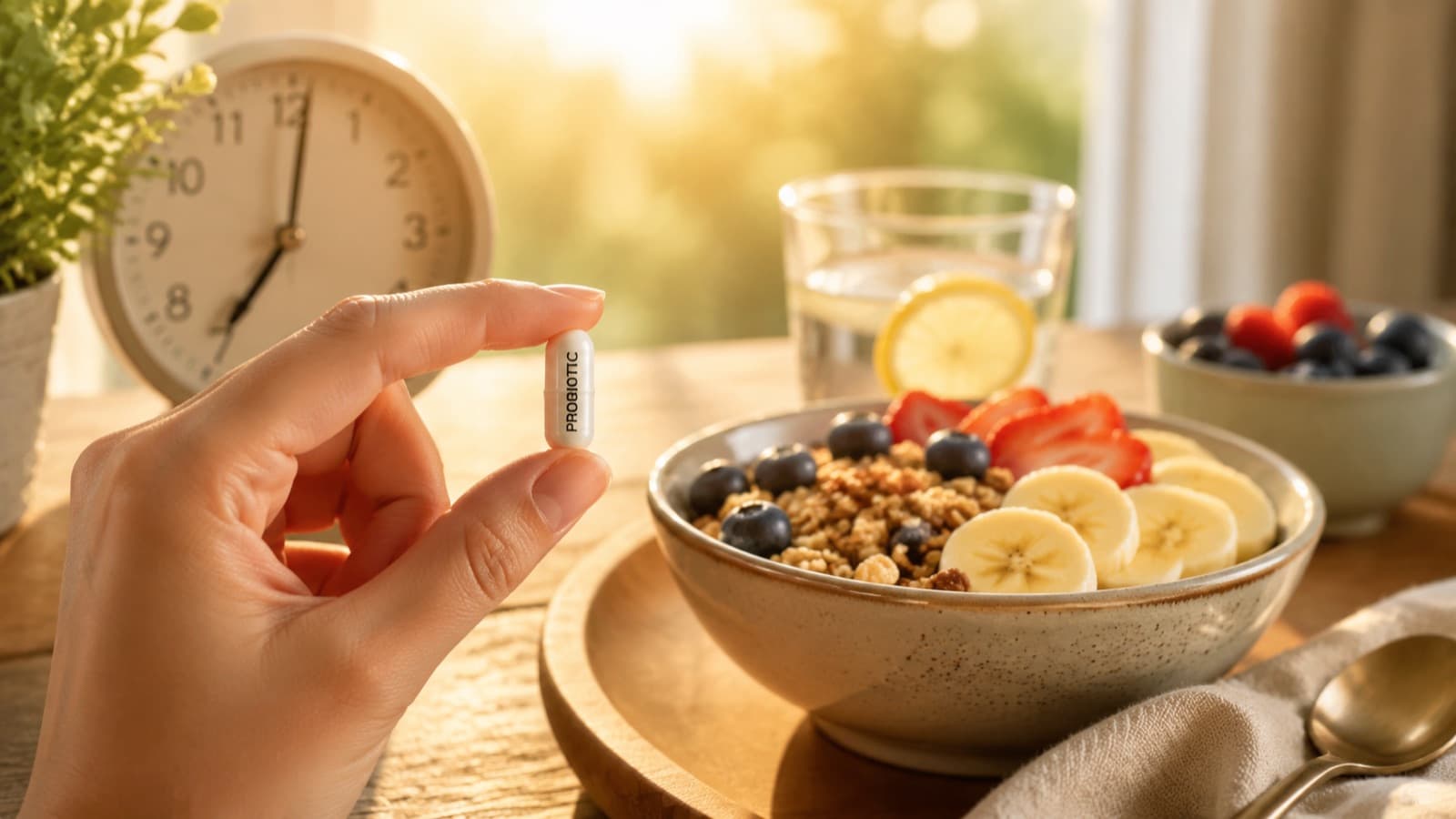
My protocol based on this: I take my probiotic right before breakfast, which is usually eggs and toast or oatmeal. The food follows within a minute or two. The bacteria get the acid buffer and the fat protection.
What About Training Days?
Here's where things get specific for people who work out.
During exercise, blood flow to the gut drops significantly (up to 80% during intense training). Your digestive system goes into standby. Gut motility slows. The environment in your GI tract changes.
Taking a probiotic immediately before a workout means those bacteria arrive in a gut that's about to shut down its normal processes. Not ideal. Taking one immediately after a workout means they arrive in a gut that's still recovering and potentially inflamed from the exercise stress.
Neither scenario is great.
The best approach for training days:
If you train in the morning: Take your probiotic with breakfast, then wait at least an hour before training. Or take it with a meal later in the day that's well separated from your training window.
If you train midday: Take your probiotic with breakfast (morning is fine since your workout is hours away).
If you train in the evening: Take your probiotic with breakfast or lunch. Well before your evening session.
The goal: get the probiotic into your system during a period when your gut is functioning normally, not during or immediately around intense exercise.
I train in the morning most days. My probiotic goes down with breakfast at 6:30 AM. I hit the gym at 8 AM. That gives about 90 minutes for the bacteria to transit through my stomach while my gut is still operating normally.
Morning vs Night: Does It Matter?
People ask this a lot. And honestly, the research doesn't show a major difference between morning and evening dosing in terms of bacterial survival or colonization, as long as you're following the "with food" rule.
That said, there are practical reasons to prefer one over the other.
Morning advantages:
- You're more likely to remember (habit stacking with breakfast)
- Your gut is in a resting, non-stressed state
- You can separate it from training if you work out later
Evening advantages:
- Some people find probiotics mildly relaxing (certain strains influence GABA production)
- Your gut does significant repair work during sleep
- If you train in the morning, evening dosing creates maximum separation from exercise
I've tried both. Settled on morning because consistency matters more than optimization. The best time to take probiotics is the time you'll actually remember to take them. If evening works better for your schedule, go with evening. The difference between morning and evening is small. The difference between taking them consistently and forgetting half the time is huge.
Spore-Based Probiotics Change the Rules
Everything I've said so far applies primarily to traditional probiotics containing Lactobacillus and Bifidobacterium strains. These are fragile organisms that need help surviving stomach acid.
Spore-based (soil-based) probiotics are a different story.
Strains like Bacillus coagulans, Bacillus subtilis, and Bacillus clausii form endospores. These are essentially biological armor. The bacteria encase themselves in a protective shell that is resistant to stomach acid, heat, and antibiotics. They don't activate until they reach the more favorable environment of your small intestine.
A study published in the European Journal of Nutrition confirmed that spore-forming Bacillus strains show nearly 100% survival through gastric transit regardless of food intake.
What this means practically: if you're taking a spore-based probiotic, timing matters much less. You can take it fasted, with food, before training, after training. The spores protect the bacteria regardless of stomach acid levels.
Products like Just Thrive Probiotic fall into this category. I tested it for three weeks and found it effective. One of its biggest practical advantages is this timing flexibility.
If you're someone who struggles with consistent timing or who wants to take a probiotic around training without worrying about survival, spore-based might be the better category for you.
What About Multi-Strain vs Single-Strain Timing?
Some probiotic supplements contain a single strain. Others contain 10, 15, even 30+ strains. Does the number of strains affect timing?
Not directly. The same stomach acid principles apply regardless of how many strains are in the capsule.
But there's an indirect consideration. Multi-strain products often use higher CFU counts (colony forming units) to account for expected die-off during transit. A product with 50 billion CFU is already assuming that a large percentage won't survive. The timing rules still apply, but the product is engineered with losses in mind.
High-quality multi-strain products like Seed DS-01 use delivery systems (nested capsule technology in Seed's case) that protect the bacteria through stomach acid regardless of timing. It's an engineering solution to the timing problem.
If your probiotic doesn't use a special delivery mechanism, timing becomes more important. If it does, you have more flexibility.
The Antibiotic Consideration
If you're taking probiotics alongside antibiotics (which is a good idea to protect your gut flora during antibiotic treatment), timing is critical.
Separate your probiotic from your antibiotic by at least 2-3 hours. If you take them together, the antibiotic will kill the probiotic bacteria before they can do anything useful.
A reasonable protocol during antibiotic treatment:
- Take your antibiotic as prescribed (often with meals)
- Take your probiotic 2-3 hours later, also with a small snack or meal
- Continue the probiotic for at least 2-4 weeks after finishing the antibiotic course
Spore-based probiotics have an advantage here too. Their endospores are resistant to most antibiotics, making timing less critical (though separation is still recommended as a precaution).
Caffeine, Supplements, and Interactions
A few other timing considerations people ask about:
Coffee/caffeine: Hot coffee can kill probiotic bacteria on contact. Don't mix probiotics into your coffee. Taking a probiotic capsule and then drinking coffee 10-15 minutes later is fine since the capsule provides some protection during initial transit. But ideally, put a little food between them.
Protein shakes: You can take probiotics with a protein shake, but the protein powder itself can cause gut issues for some people. If you're taking a probiotic to fix the very gut problems your shake is causing, address the shake first.
Other supplements: Most supplements don't interact with probiotics in meaningful ways. The exception is anything highly acidic (vitamin C in large doses, apple cider vinegar) which can lower stomach pH further. Separate these by 30 minutes if possible.
Prebiotics: Taking probiotics and prebiotics together (or using a synbiotic that contains both) is fine and potentially beneficial. The prebiotic fiber provides food for the probiotic bacteria. Products like Seed DS-01 combine both in a single product.
My Exact Probiotic Timing Protocol
After testing various approaches over the past couple of years, here's exactly what I do:
Non-training days:
- Wake up, take probiotic with first bite of breakfast
- Breakfast always includes some fat (eggs, nut butter, or avocado)
- Simple. Consistent. Done.
Training days (morning sessions):
- 6:30 AM: Probiotic with breakfast
- 7:00 AM: Pre-workout prep
- 8:00 AM: Train
- 9:30 AM: Post-workout shake
The 90-minute gap between probiotic ingestion and training gives enough transit time for the bacteria to clear my stomach before blood flow redirects.
Training days (evening sessions):
- Probiotic with breakfast (same as above)
- Train at 5-6 PM
- No probiotic-related adjustments needed since it was taken 10+ hours earlier
The Bottom Line on Probiotic Timing
Here's the hierarchy of what matters, ranked:
- Consistency (taking it daily matters more than perfect timing)
- With food (specifically with a meal containing some fat)
- Before or at the start of a meal (not 30+ minutes after)
- Separated from intense exercise (at least 60-90 minutes before training)
- Morning vs evening (marginal difference, pick what's sustainable)
If you're using a spore-based probiotic, only point 1 really matters. Points 2-5 are largely irrelevant due to the endospore protection.
Don't overthink this. The best time to take probiotics is when you'll actually remember to take them, with food, and not right before you go crush a hard workout. That's it.
Your gut bacteria don't care about your optimization spreadsheet. They care about showing up alive and having something to eat when they get there. Give them that and they'll do their job.